REVIVE: Just Restoration and Equitable Value Chains for Inclusive, Viable Mangrove Ecosystems: The case of Malaysia

Project Summary

Countries: Malaysia

Delivery Partner: The University of Manchester

Principal Investigator: Dr Aarti Krishnan, Developmental Economist, University of Manchester


Challenge

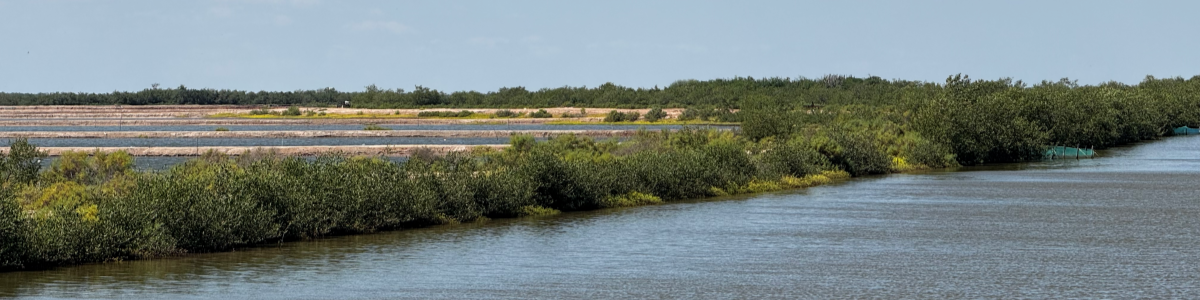
REVIVE builds scalable, evidence-based pathways for just restoration in Malaysia. Mangroves buffer storms, sustain fisheries, and store carbon, yet top-down, science-only restoration have seldom delivered self-sustaining models that balance climatebiodiversity with fair livelihoods. Also, value chains draw on mangrove resources, but channel rents to intermediaries, leaving communities in low-skill roles facing trade-offs exacerbating social inequality and ecological loss.

REVIVE develops and tests hybrid co-governance that couples community participation (CP)-voice in decisions, grievance redress, shared monitoring with value chain (VC) upgrading into highervalue diversified products/services. We track impacts using three measures: Just Restoration Index (carbon, social, economic); Restoration Stewardship Index (collective capacity and agency); and a Restoration Imaginaries Index (shared future visions), alongside explicit trade-off analysis.

Working in Matang Mangrove Forest Reserve (MMFR), Sungai Acheh & Sungai Chenaam (SASCM), and Setiu Wetlands (SWMT) we run a RCT (Control; CP; CP+VC) integrated with habitatsuitability, blue-carbon modelling, co-production, digital ethnography, and agent-based modelling to identify CP×VC configurations that are effective and equitable.

Outputs include a Restorative Business Model Canvas, reporting app, open maps/datasets/code, policy and industry briefs, Community of Practice for scale-out. Communities (especially women and youth) gain agency, better jobs; state forestry/NGOs/ certifiers gain auditable metrics and evidence; firms gain ESG opportunities; donors gain carbon and justice baselines, supporting transformational change.


More on the project will be added soon.

In the meantime, explore our Projects page to discover the diverse portfolio of initiatives GCBC is supporting around the world, and see where our research is making an impact.
Regenerative Island Futures: Unlocking sustainable food-system opportunities for Ecotourism in SIDS

Project Summary

Countries: Fiji

Delivery Partner: Bioversity International

Principal Investigator: Dr Gina Kennedy, Principal Scientist, Bioversity International


Challenge

Communities in Small Island Developing States face interconnected challenges of climate vulnerability, biodiversity loss, and limited economic opportunities. This research will develop a contextualized, evidence-based approach that leverages the expanding ecotourism market to catalyze climate-smart, biodiversity-based supply and demand solutions.

With Vanua Levu, Fiji as the case study, we will demonstrate how restoring the use of local biodiversity can diversify community incomes, reverse ecological decline, and strengthen climate resilience, creating a transformational pathway for SIDS. Applied, evidence-based research will build resilience by increasing both the supply and demand of native biodiversity. Communities, in collaboration with the research team, will co-develop solutions for biodiversity-based landscape restoration and climate-smart agriculture to boost supply, while culinary and gastronomy opportunities will be tailored to meet the growing demand of ecotourism.

The project will directly benefit actors across ecotourism value chains, including input suppliers (seedlings, planting materials, compost), local producers (farms and markets), and the culinary sector (food processing and preparation), with intentional focus on women and youth. Additional beneficiaries include policymakers, government agencies, researchers, donors, and the broader tourism industry in Fiji and other SIDS, who will gain evidence and tools to guide investment, implementation and policy decisions.


More on the project will be added soon.

In the meantime, explore our Projects page to discover the diverse portfolio of initiatives GCBC is supporting around the world, and see where our research is making an impact.
Sustainable Aquaponics for Food Security and Community Empowerment in São Tomé and Príncipe

Project Summary

Countries: São Tomé & Príncipe

Principal Investigator: Idalina Dias Sardinha, Invited Associate Professor at ISEG and Senior Researcher at ISEG Research, Universidade de Lisboa, specialising in Sustainability Science.


Challenge

This SISTA project addresses the critical nexus of poverty, climate vulnerability, and biodiversity loss in São Tomé and Príncipe by establishing a sustainable, community-driven aquaponics model. Our innovative approach will develop a climate-resilient pilot system using local materials, integrating tilapia with the native freshwater prawn to enhance biodiversity. A key element is the creation of an eco-efficient, closed-loop system based on principles of circular economy, by producing sustainable fish feed from local agricultural waste, thereby overcoming a major cost driver for aquaponics in Small Island Developing States (SIDS) and minimizing environmental impact.

Therefore, SISTA employs a transdisciplinary methodology, structured in three phases: 1) Co-design and Pilot Implementation, 2) Vocational Training and Capacity Building, and 3) Scaling and Enterprise Development.

The project’s transformative change is anchored in identifying and establishing the essential technical, socio-economic and institutional enablers of aquaponics, such as inclusive governance and sustainable business models, that ensure long-term community ownership of 10–15 community-managed units.

This foundation empowers vulnerable groups, especially women and youth, through a comprehensive vocational training program, fostering local entrepreneurship and livelihoods. By scaling this proven model to 10–15 community-managed units, SISTA will directly enhance food security, increase incomes, and build climate resilience. Co-created with local partners, the project delivers a scalable blueprint for sustainable food production that ensures long-term impact and serves as a model for other SIDS.


More on the project will be added soon.

In the meantime, explore our Projects page to discover the diverse portfolio of initiatives GCBC is supporting around the world, and see where our research is making an impact.
Jornada de Puertas Abiertas del Simposio de Investigación GCBC 2025

Cada año, el Centro Global de Biodiversidad para el Clima organiza un simposio de investigación centrado en compartir grandes ideas, prácticas transformadoras e historias de impacto.

Este año, invitamos a toda la comunidad del GCBC a participar en el evento a través de una Jornada de Puertas Abiertas online el martes 4 de marzo de 2025.

El programa de la Jornada de Puertas Abiertas incluyó cuatro atractivas sesiones con ponentes de todo el mundo. Puedes acceder a las grabaciones de las sesiones más abajo.

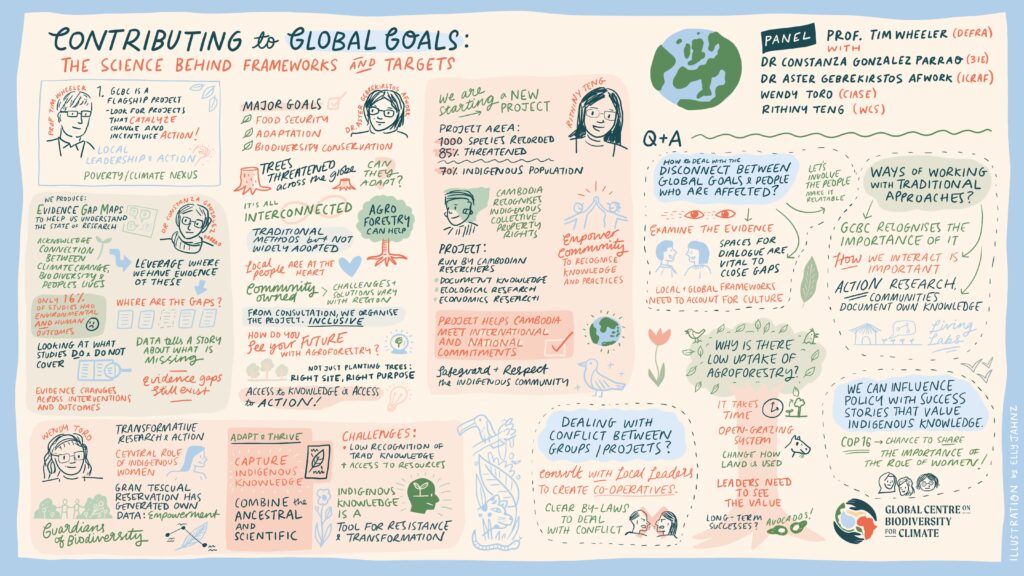
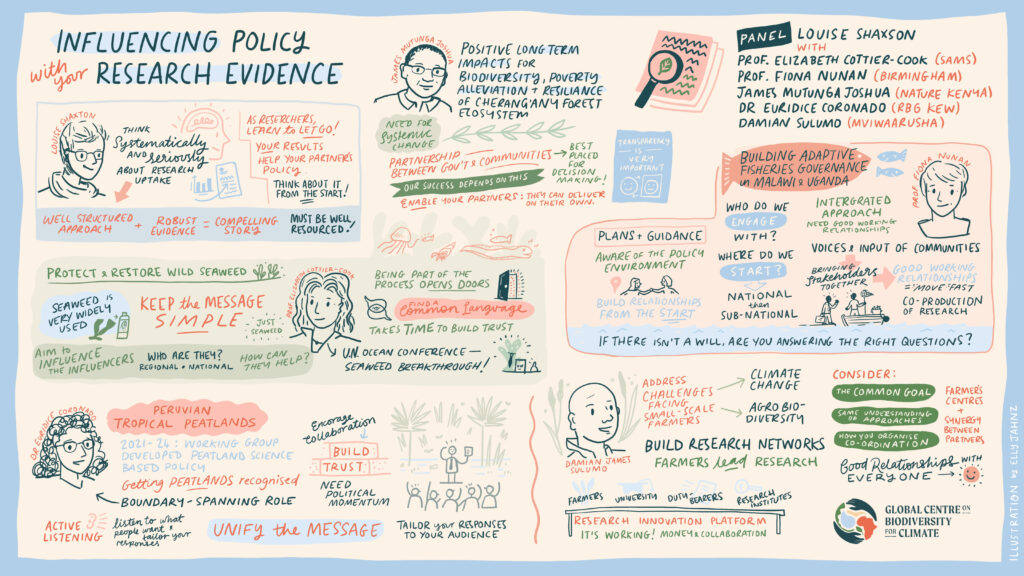
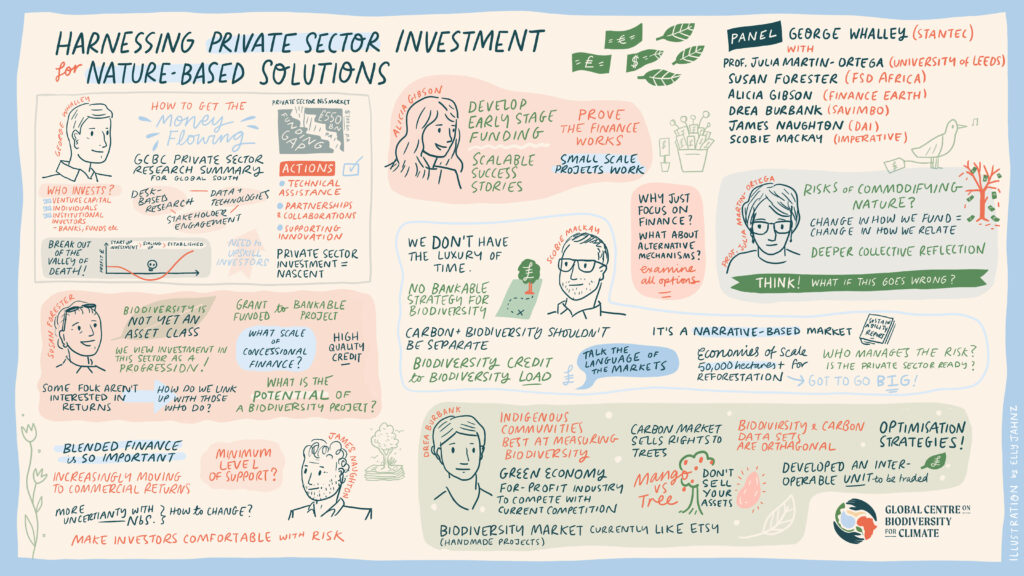
Además, las principales conclusiones de cada mesa redonda han cobrado vida gracias a las ilustraciones de Elly Jahnz.
 

Sesión inaugural: Por qué es importante apoyar la investigación innovadora en la intersección del cambio climático, la pérdida de biodiversidad y la mitigación de la pobreza.


Mesa redonda 1: Contribuir a los objetivos globales – Explorar la ciencia que subyace a los marcos y objetivos nacionales y globales.


Mesa redonda 2: Reforzar la conexión entre las pruebas y la política con un enfoque práctico de toda la comunidad del GCBC.


Mesa redonda 3: Aprovechar la inversión del sector privado en soluciones basadas en la naturaleza.


Para más información, lee nuestro blog sobre el Simposio, escrito por Samantha Morris, en el que se analizan los principales resultados del evento completo de tres días.

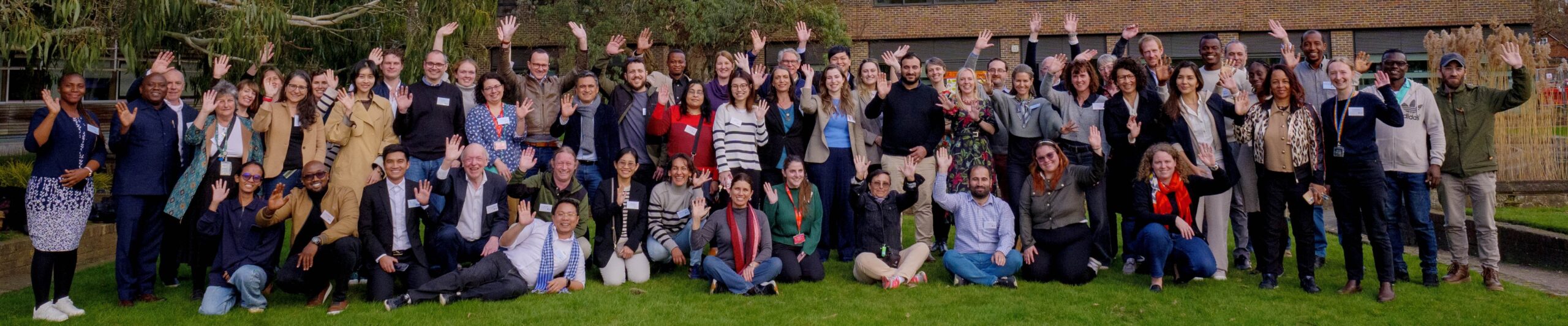
Muchas gracias a todos los miembros de nuestra comunidad de investigación del GCBC que se unieron a nosotros en persona y por Internet para el simposio, y a nuestros maravillosos ponentes, panelistas y presidentes por su perspicacia, experiencia y por dedicar generosamente su tiempo a estar con nosotros.

Biodiversity for Climate and Social Resilience: Empowerment of Coastal Communities in Sustainable Production Practices in Ecuador

Project Summary

Countries: Ecuador

Principle Investigator: Professor Julia Nieto Wigby, ESPOL

Project Description

The project aims to mitigate climate change by enhancing mangrove health, reducing human impact, and increasing fishing communities’ resilience while providing fair alternative incomes. Innovative techniques and approaches are applied to improve environmental, climate and social resilience along with novel finance solutions.

This involves: a) Ecosystem recovery – evaluating trophic structure recovery through habitat restoration strategies such as cultured black cockle (BC) restocking and red mangrove afforestation; b) Ecosystem protection – offering alternative livelihoods to reduce fishing pressure on natural banks by transferring technical mariculture capacities to fisher communities, along with environmental education and social empowerment for inclusive community governance systems; and c) Valorisation – internalising ecosystem services to determine real BC extraction and trade costs, and functional ecology valuation.

Communities will use key information to demand national policies to protect their territories and livelihoods.

Photograph (detail): Diego Tirira

TRIALS – Traducir la investigación en acción para los medios de subsistencia y los pastos marinos: Establecimiento de una base científica para la restauración de los pastos marinos y el potencial de carbono azul, con el desarrollo de medios de vida sostenibles para las comunidades costeras de Vietnam Central.

País: Vietnam Socio principal: WWF-Reino Unido Resumen: Este proyecto abordará las lagunas de conocimiento científico sobre el estado de las praderas marinas, su restauración y la biodiversidad marina asociada y el potencial de carbono azul en Vietnam Central. Ideará opciones de subsistencia mejoradas, sostenibles y resistentes al clima para las comunidades costeras locales, destacando los beneficios ecológicos, económicos, sociales y de resiliencia comunitaria interconectados de los ecosistemas de praderas marinas, y apoyando planes de acción y políticas basados en pruebas para la conservación de las praderas marinas y el carbono azul.

Fomento de la capacidad de adaptación de la gobernanza pesquera

Países: Uganda, Malawi

Socio de ejecución: Universidad de Birmingham

Resumen: Esta investigación tendrá efectos positivos en la biodiversidad, la mitigación de la pobreza y la mejora de la resistencia de los ecosistemas mediante el fortalecimiento de la capacidad de gobernanza adaptativa de la pesca continental en Malawi y Uganda. La investigación adoptará un enfoque de coproducción transdisciplinar, colaborando estrechamente con los departamentos de pesca, las ONG y las comunidades locales en todas las actividades, y facilitará el aprendizaje Sur-Sur. El proyecto incluirá la evaluación de la capacidad de gobernanza adaptativa a nivel nacional, de distrito y de comunidad, estudios sobre la generación de información y el cambio de las prácticas pesqueras, y el aprendizaje de la investigación-acción con intervenciones piloto de protección de la biodiversidad y reuniones de redes. Se generarán nuevas pruebas y se desarrollarán planes de gobernanza adaptativa.