Evaluating Blue Carbon Strategies for Protecting Wild Seaweeds
New ways of financing international efforts to protect and restore threatened seaweeds could help safeguard the wider natural environment, according to an environmental economist at the Scottish Association for Marine Science (SAMS).
Dr Niko Howai, has joined the GlobalSeaweed-SUPERSTAR team to evaluate how various mechanisms of so-called ‘blue finance’ can be applied to seaweed protection and restoration, particularly in tropical regions of the world.
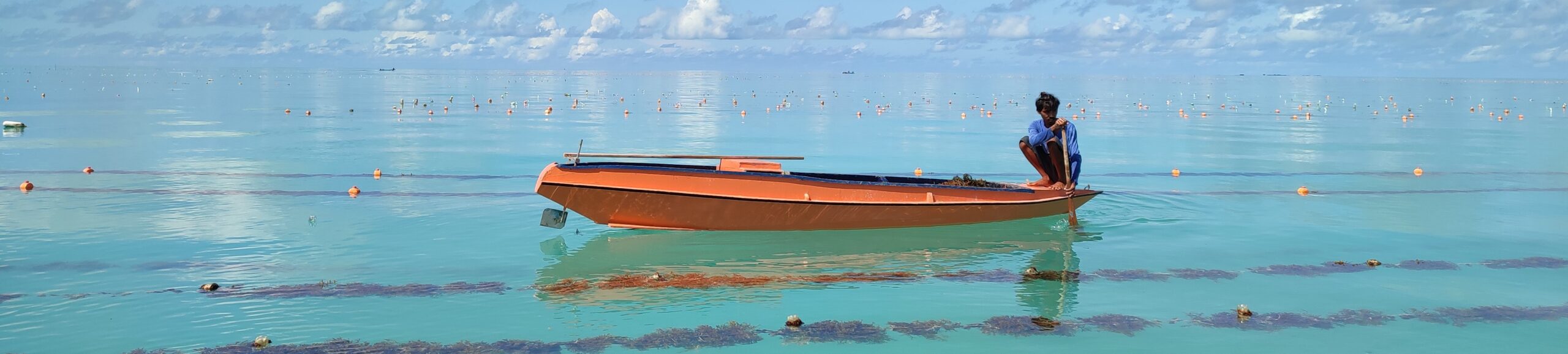
Threats such as global climate change, overharvesting, pollution and an increase in invasive non-native species, could result in dramatic changes in distribution and diversity of seaweed species. These would not only negatively affect the natural environment and wild seaweed stocks but also threaten the livelihoods of millions of seaweed farmers that rely on a healthy environment to grow their crops and the wild cultivars for future climate-resilient varieties.
However, Dr Howai believes evaluating the blue finance options available to protect and restore seaweed across potentially conflicting and multi-faceted decisions, may help to safeguard their future.

There is currently a huge shortfall in the finance required to support seaweed protection and restoration initiatives, which are totally absent in many countries worldwide. If we are looking at the safeguarding the seaweed farming industry, we need a mechanism of financial incentive to help protect and restore wild seaweed populations. It is not enough to look only at things like a farmer’s access to credit; we must also consider the health of the environment in which they work and how this all fits in with the UN Sustainable Development Goals.
Dr Niko Howai, Scottish Association for Marine Sciences
Blue Finance Mechanisms
With an initial focus on South-east Asia, Dr Howai will investigate four possible blue finance mechanisms for the seaweed protection and restoration: blue bonds, blue carbon credits, debt for nature swaps and blended finance.
He will assess the effectiveness of each mechanism by applying five evaluation criteria: environmental and ocean protection, community benefits and social inclusion, financial strength and viability, governance and transparency, and policy alignment and innovation.
By interviewing experts in finance, he will score each mechanism and recommend them most effective method to help sustain seaweed protection and restoration and to protect the wider environment.
GlobalSeaweed-SUPERSTAR, which is funded by the Global Centre on Biodiversity for Climate and led by SAMS, recently published The State of the World’s Seaweeds report, which combines the most up-to-date scientific evidence on the threats facing global seaweed habitats.
The report emphasises that despite the importance of seaweeds, and the severity of the threats they face, they are afforded inadequate conservation measures. Authors of the report have called for these major gaps to be addressed.
If we can identify a mechanism of blue finance that is effective on environmental protection, societal inclusion, financial strength, governance and policy alignment, it could go some way to improving the protection and restoration of threatened seaweeds, whilst securing a sustainable future for the seaweed farming industry.
Prof. Elizabeth Cottier Cook, Principal Investigator, GlobalSeaweed-SUPERSTAR
For further details on the GlobalSeaweed‑SUPERSTAR project and its partners, please visit the project page.